

Wondering what brake service on your Audi or Mercedes-Benz should include, and how to tell when it is time? If you drive in Tampa, your brakes work hard: stop-and-go traffic, summer heat and heavy afternoon rain all add up. This guide covers what a proper brake service involves, the warning signs, and what to ask before the work starts.
The short answer: a proper brake service on an Audi or Mercedes-Benz measures the pads and rotors against the manufacturer's minimums, replaces the pad wear sensor if it has triggered, inspects the calipers, slide pins and brake hoses, and checks the brake fluid for moisture. Pads are replaced when worn to their limit, and rotors when thin, scored or uneven.
In practice, a complete brake service typically includes:
- Pad and rotor thickness measurements, front and rear
- New pads, plus rotors if they are thin, scored or uneven
- A new pad wear sensor where the old one has triggered
- Caliper, slide pin and brake hose inspection
- A brake fluid condition check
- A road test to confirm even, quiet stopping
A brake job on an Audi or Mercedes-Benz is not the same job as on a commuter sedan. The parts are matched to each model, the cars report pad wear electronically, and the brake system works hand in hand with ABS and stability control.
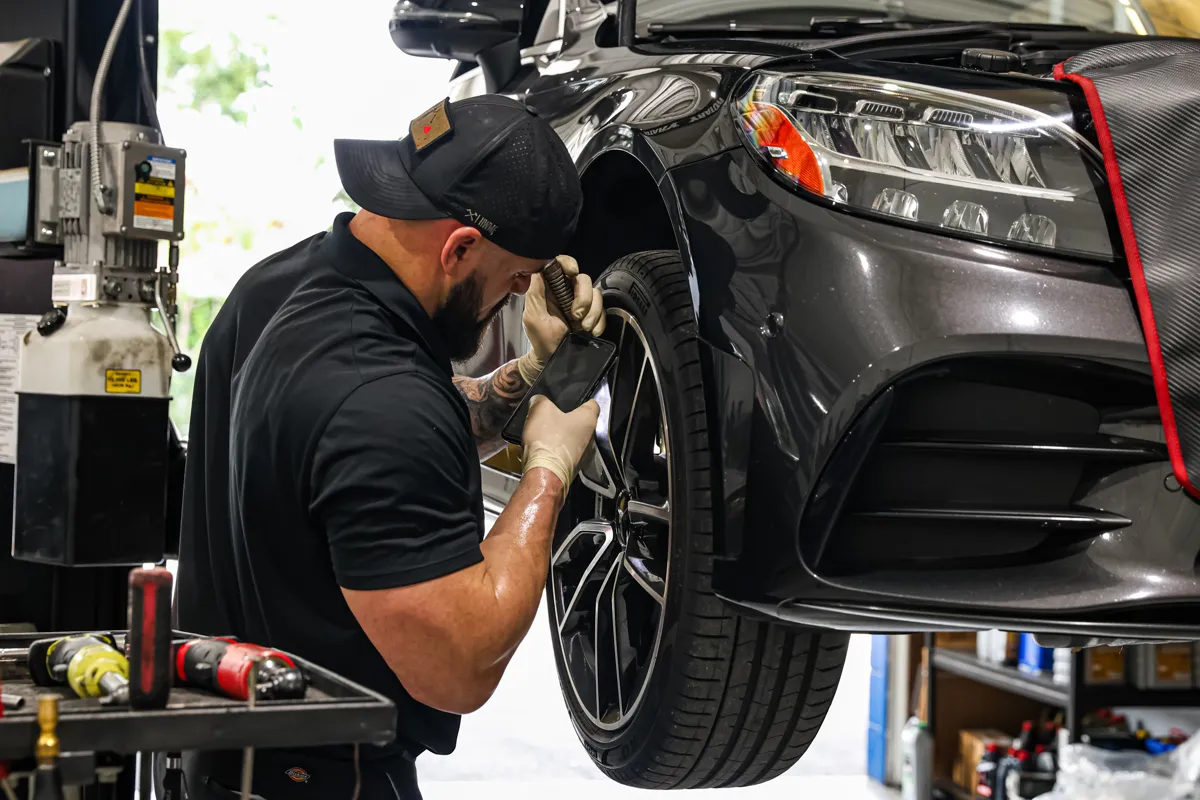
How German Brakes Are Built Differently
A car like an Audi A4 or Q5, or a Mercedes-Benz C-Class or GLC, is engineered as a system: the pad compound, rotor design and caliper size are chosen together for that model's weight and performance.
Swap in a part that only "fits," and the system can behave differently. A pad with the wrong friction rating can change pedal feel, add noise, or wear the rotor unevenly.
Friction material is always a trade-off. A softer, grippier compound bites harder and resists heat fade, but it tends to wear faster and shed more dust. A harder compound lasts longer but may feel less sharp. Manufacturers pick that balance for each model, which is one reason matched parts matter.
Three things set these cars apart:
- Electronic pad wear sensors that report pad thickness to the dashboard
- Model- and trim-specific parts: two cars with the same badge can use different brake sizes
- Tight integration with ABS and stability control, which rely on the brakes responding evenly at every wheel
Every stop turns your car's motion into heat. The pads and rotors absorb most of it, and the caliper and fluid carry part of it. That is why a worn part in one place, such as a thin rotor that cannot hold heat, can show up somewhere else as a soft pedal or vibration.
Pads vs. Rotors: What Each Part Does
Estimates often list pads and rotors separately, and it helps to know what each part does.
| Brake pads | Brake rotors | |
|---|---|---|
| What it does | Friction material the caliper squeezes against the rotor | Metal disc that turns with the wheel and absorbs the heat of stopping |
| How it wears | Gets thinner every stop | Gets thinner more slowly; can develop grooves, lips or uneven thickness |
| How we check it | Pad thickness on both inner and outer pads | Measured against the minimum thickness stamped by the manufacturer |
| Typical warning | Dash pad-wear message, squeal or grinding | Pulsing pedal or steering wheel shake under braking |
| Replace when | Worn to the limit or the sensor has triggered | Below minimum thickness, scored or uneven |
Rotors carry a minimum thickness stamped on them by the manufacturer. Below that number a rotor holds less heat and is more likely to warp or crack, so it should be measured with a micrometer rather than judged by eye. Resurfacing removes a little metal to restore a flat face, but it is only an option when enough thickness remains.
What a Proper Brake Service Covers
Every car is different, but a thorough brake service on an Audi or Mercedes-Benz looks at:
- Pads: thickness and even wear, inner and outer
- Rotors: measured against the manufacturer's minimum, checked for scoring or uneven wear
- Calipers and slide pins: checked for sticking or leaks, which cause one pad to wear faster than the other
- Lines and hoses: checked for leaks, cracks or corrosion
- Brake fluid: checked for condition and moisture
- Pad wear sensors: replaced when they have been triggered
Calipers deserve a closer look than they usually get. The caliper slides on pins that must move freely. When a pin seizes or its rubber boot tears, the pad stays pressed against the rotor or presses unevenly. One pad then wears faster, the rotor heats up on one side, and the car may pull when you brake. Replacing pads without freeing the slides can bring the same problem back.
At Just German Automotive, our brake repair services include pad replacement, rotor resurfacing and replacement, brake line flushing and replacement, and caliper inspection and replacement.
Ceramic vs. Semi-Metallic Brake Pads
Many Audi and Mercedes-Benz models can be fitted with either ceramic or semi-metallic pads, depending on the model and what the manufacturer specifies. These are general characteristics, and the right choice for your car is the one that matches its factory specification and how you drive.
| Ceramic pads | Semi-metallic pads | |
|---|---|---|
| Made of | Ceramic fibers and fillers, often with some copper or other metal fibers | Steel, iron or copper fibers bonded with resin |
| Noise | Generally quieter | Can be noisier |
| Dust | Generally lighter, lighter-colored dust | Often darker, heavier dust |
| Heat handling | Good in everyday driving; some compounds fade under very hard use | Generally strong at high temperatures and heavy braking |
| Rotor wear | Generally gentler on rotors | Can be harder on rotors |
| Cold bite | Can feel less aggressive when cold | Often grabs well when cold |
Compounds vary a lot between brands, so these are tendencies, not rules. Before choosing a pad, ask which one the manufacturer specifies for your model, and whether you tow, drive hard or mostly commute.
How Long Does Brake Service Take?
Time varies with the car, the parts and what the inspection finds, so treat any figure as a rough guide. As a general industry range, replacing pads on one axle is often a matter of a couple of hours or less, and pads and rotors on both axles can take longer. Seized hardware, leaking calipers, a brake fluid exchange or parts that must be ordered can add time. Ask your shop for an estimate once the car has been inspected, and whether it should be at the shop for the day.
Why the Pad Wear Sensor Gets Replaced
On many Audi and Mercedes-Benz models, a small sensor sits in the pad. When the pad wears down to its limit, the friction material wears into the sensor and breaks its circuit, which turns on the dash warning.
That is why a triggered sensor is a one-time part: once its circuit is worn through, it cannot reset. Reusing it can leave the warning on, or leave the car with no warning next time.
Brake Fluid: The Part Most Estimates Skip
Brake fluid is hygroscopic, which means it slowly pulls moisture out of the air. Water in the fluid lowers its boiling point.
Under repeated hard stops, the fluid near the caliper can get hot enough to boil. Vapor compresses where fluid does not, so the pedal goes soft or sinks right when you need it most.
Because moisture builds with time, not miles, Audi and Mercedes-Benz list brake fluid replacement on a time interval in their maintenance schedules. Your service booklet or our Mercedes service team can tell you when yours is due.
Tampa Driving Is Hard on Brakes
Local conditions play a real part in how fast brakes wear here:
- Stop-and-go city traffic means more braking cycles and more heat
- Summer heat adds to the temperature the brakes already produce
- Afternoon thunderstorms and humidity put moisture on rotors, which can leave a light layer of surface rust after the car sits, and moisture in the air ends up in the brake fluid over time
Florida also has no periodic vehicle safety inspection, so nobody checks your brakes unless you ask. That makes a measured inspection at each pad replacement or oil service more important here than in states that inspect every year.
For more, see our posts on how Tampa rainstorms affect brakes and how long brakes actually last.
Worn Brakes and Your Safety
Worn brakes do not usually fail all at once. They get a little worse every week, which is why drivers stop noticing.
- Stopping distance: thin pads, glazed rotors and old fluid all add distance, and the energy your brakes must absorb grows with the square of speed, so the difference shows up most at highway speed
- ABS behavior: ABS can keep the wheels from locking, but it cannot add grip or make up for parts that are not doing their job
- Swerve control: a sticking caliper or uneven pads make the car pull under braking, which is the last thing you want during an emergency lane change
- Tire wear: a dragging caliper also adds heat and wear at that corner
Pulling or vibration is not always the brakes. Worn suspension parts or poor alignment can cause similar symptoms, so a good inspection looks at those too. See our suspension service page and our post on wheel alignments for German vehicles.
Signs Your Audi or Mercedes Needs Brake Service
- A brake pad warning or brake system message on the dash
- Squealing, grinding or scraping when you brake
- A soft, spongy or low pedal
- Vibration in the steering wheel or pedal when stopping
- The car pulling to one side under braking
- A burning smell or one wheel much dirtier with dust than the others
If you notice more than one of these, or the car does not stop the way it used to, have the brakes checked before driving more than you need to.
Questions to Ask Before Brake Work
- Which parts need replacing now, and which can wait?
- What did the rotors measure, and what is the minimum thickness?
- Does the car need a new pad wear sensor?
- Which pad type is being installed, and does it match the manufacturer's specification?
- How long will the work take, and what could add time?
- When was the brake fluid last replaced?
Frequently Asked Questions
Do Audi and Mercedes-Benz brakes wear faster than other cars?
Often, yes, because the pad compounds that deliver strong, consistent stopping tend to wear faster and shed more dust than long-life economy pads. Heavy stop-and-go traffic shortens pad life on any car.
Should rotors be replaced with every pad change?
No, rotors only need replacing when they are too thin, scored or uneven. New pads need a flat, even surface to bed into. If the rotors are above the manufacturer's minimum thickness and wear evenly, they can sometimes be reused or resurfaced. If they are thin, they hold less heat and are more likely to shake under braking, so replacing them is the better choice. Measuring is the only way to know.
Why is there so much black dust on my wheels?
Usually it is normal: the grippy, heat-resistant pad compounds used on many German cars shed more visible dust as they wear. A sudden change, or heavy dust on only one wheel, can mean a sticking caliper, so it is worth having checked.
Why do I need a new wear sensor with new pads?
Because a sensor that has triggered cannot be reset. Once the pad wears into it, its circuit is broken for good, so reusing it either keeps the warning on or leaves you without a warning the next time the pads run low.
Why does brake fluid need changing if it is not low?
Because the problem is water, not fluid level. Brake fluid absorbs moisture over time, which lowers its boiling point. During hard or repeated braking the fluid can boil and the pedal goes soft. Old fluid can also let moisture reach metal parts inside the system. That is why manufacturers list it on a time schedule.
Does Florida require a brake inspection?
No, Florida does not require a periodic brake inspection. Florida does not have a periodic safety inspection for passenger cars, so the condition of your brakes is up to you and your shop. Asking for pad and rotor measurements at each service is the simplest way to stay ahead of it.
Brake Service for Your Audi or Mercedes-Benz
Just German Automotive works only on German makes: Audi, BMW, MINI, Mercedes-Benz, Porsche and Volkswagen. Our technicians are ASE certified and factory-trained, and our work is covered by a 3-year/36,000-mile nationwide warranty.
Just German Automotive
4411 N Lois Ave, Tampa, FL 33614
About two miles from Tampa International Airport
Monday to Friday, 8:00am to 5:00pm. Closed Saturday and Sunday.
See our brake repair page and our Audi and Mercedes-Benz service pages, then book an appointment or contact us.
